Category: Child Protection & Human Rights
Discussing sexual violence prevention with young children and families is one of the most sensitive dilemmas faced by parents, caregivers, and educators. The fear of shocking them, shattering their innocence, or inducing unnecessary anxiety often leads to silence. However, experience and data show that silence is precisely the environment in which perpetrators find it easiest to operate.
For decades, traditional prevention efforts focused almost exclusively on warnings like “don’t talk to strangers” or “don’t accept candy from unknown adults”. Yet, this type of advice creates a false sense of security. The vast majority of abuse cases occur within the child’s own family or close social circle, committed by familiar and trusted individuals.
To truly protect our children, we need a new approach: playful, age-appropriate empowerment.
Child Empowerment: The Key to Prevention
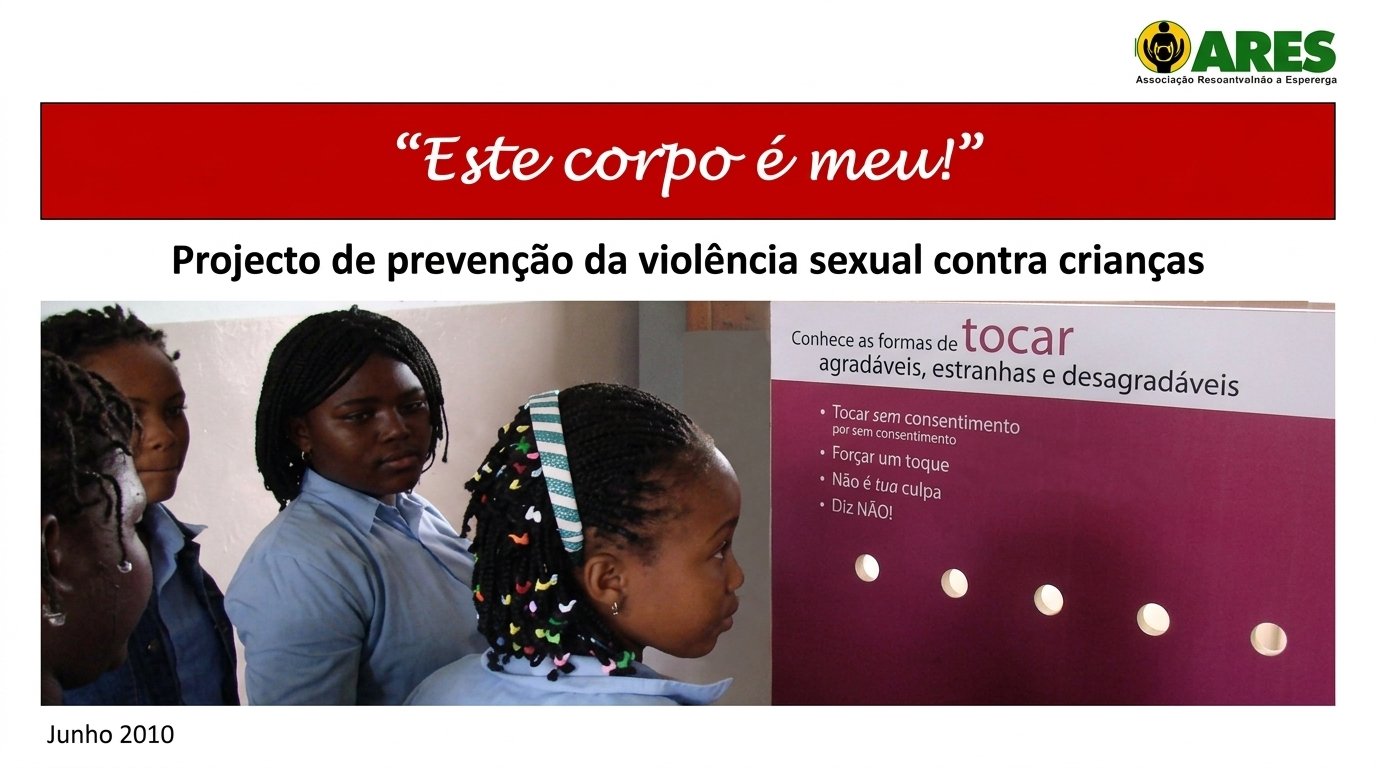
Inspired by successful initiatives developed in Germany (PETZE) and Switzerland (Stiftung Kinderschutz Schweiz), the project “Este corpo é meu!” (This body belongs to me!), adapted and implemented by ARES in Mozambique, proposes a practical behavioral shift[cite: 1].
Rather than focusing on fear or danger, the methodology playfully fosters self-esteem, body awareness, and defense strategies starting from the early years of primary school[cite: 1].
“Confident children who are aware of their rights are not only better protected against sexual abuse, but also against all forms of violence and arbitrariness.”
Children who learn proper terminology for their body parts, understand their emotions, and distinguish loving touches from uncomfortable ones gain the voice and discernment needed to identify abuse and seek help immediately.
7 Core Messages Every Child Should Learn
The “This Body Belongs to Me!” e-book structures learning around seven essential, practical pillars:
- “It is NEVER my fault” — Relieves victims of self-blame, reinforcing that adults carry sole responsibility for child protection.
- “This body belongs to me!” — The child’s body is precious, and they have a right to privacy.
- “I trust my feelings!” — Encourages children to listen to the warning signs from their own bodies.
- “I know pleasant, strange, and unpleasant touches” — No one has the right to touch their private parts.
- “I have the right to say NO!” — Reenforces that setting boundaries is a fundamental right.
- “I know the difference between good and bad secrets” — Breaks abuser coercion: secrets that cause fear or distress must never be kept.
- “I can find help!” — Asking a trusted adult for help is a sign of strength and courage.
Adults Carry the Primary Responsibility
Empowering children does not mean shifting the burden of protection onto their young shoulders. Parents, teachers, caregivers, and community members are the primary guardians of child safety.
For prevention to work effectively in daily life, adults must equip themselves with proper educational tools, learning how to talk open-heartedly without taboos or embarrassment.
Ready to Learn More and Implement This Approach in Your School or Family?
The complete e-book for the “This Body Belongs to Me!” project offers detailed pedagogical insights, classroom dynamics, and essential guidelines for parents and educators[cite: 1].
👉 CLICK HERE TO READ THE FULL E-BOOK “THIS BODY BELONGS TO ME!”
Download it for free, share it with fellow parents and teachers, and help us build a strong protective shield for our children!