Category: History & Humanitarian Education
How do you heal the invisible wounds of childhood when the surrounding world is devastated by war? Between 1987 and 1991, amidst the severe impacts of the armed conflict in Mozambique, educators and technical experts faced the urgent challenge of welcoming and reintegrating children bearing deep psychological trauma.
During the destabilization war, the majority of the rural population suffered displacement, family separation, hunger, and the destruction of schools and health posts. Thousands of children witnessed extreme violence, lost family members, and in severe cases, were abducted or forcibly trained to commit acts of violence. Given the acute shortage of trained psychologists and social workers in the country, a crucial question arose: how could thousands of vulnerable children scattered across the provinces be reached and supported?
The Answer in the Classroom: The Teacher Network
The innovative answer came from Mozambique’s Ministry of Education, through its Special Education Department. This strategy leveraged the existing network of primary school teachers as the main pillar for psychosocial and community support.
Impact on the Education Sector (1983–1989): During the critical period of the conflict, more than 53% of first-degree primary schools were destroyed or closed, resulting in overcrowded classrooms of up to 60 students per teacher in urban and accommodation areas.
Rather than relying solely on abstract theories or formal psychiatric diagnoses, the program trained educators to recognize subtle signs of emotional distress in children—such as anxiety, constant nightmares, withdrawal, aggressiveness, and distrust—and to intervene sensitively within the school environment.
Practical Support and Empathetic Listening
The project prioritized “supportive conversations”. Teachers learned to actively listen to each child’s lived experience without judgment, maintaining ethical boundaries to avoid re-traumatizing children simply to gather information.
Key methodologies included:
- Family Tracing and Reunification: Strategic partnerships with Social Action (SEAS) aimed to locate relatives or foster families, prioritizing non-institutional care.
- Expressive and Recreational Activities: Using free drawing, clay modeling, drama, and poetry to allow children to express complex emotions they could not put into words.
- School Routine & Structure: Reintegrating children into daily classroom routines provided a crucial sense of safety and stability.
Stories of Resilience and Hope
The document records striking accounts of resilience, such as the Lhanguene Center, which received 34 boys rescued from military bases, aged between 6 and 15. Through affection, structure, drama, and continuous encouragement, youth who previously exhibited severe aggression or deep mutism gradually regained trust and returned to their studies.
Longitudinal studies conducted in provinces such as Zambézia and Manica revealed the remarkable resilience of Mozambican children. When supported by trained teachers and an attentive community, the vast majority demonstrated an extraordinary capacity for emotional recovery.
Dive Deeper Into This Historical Document
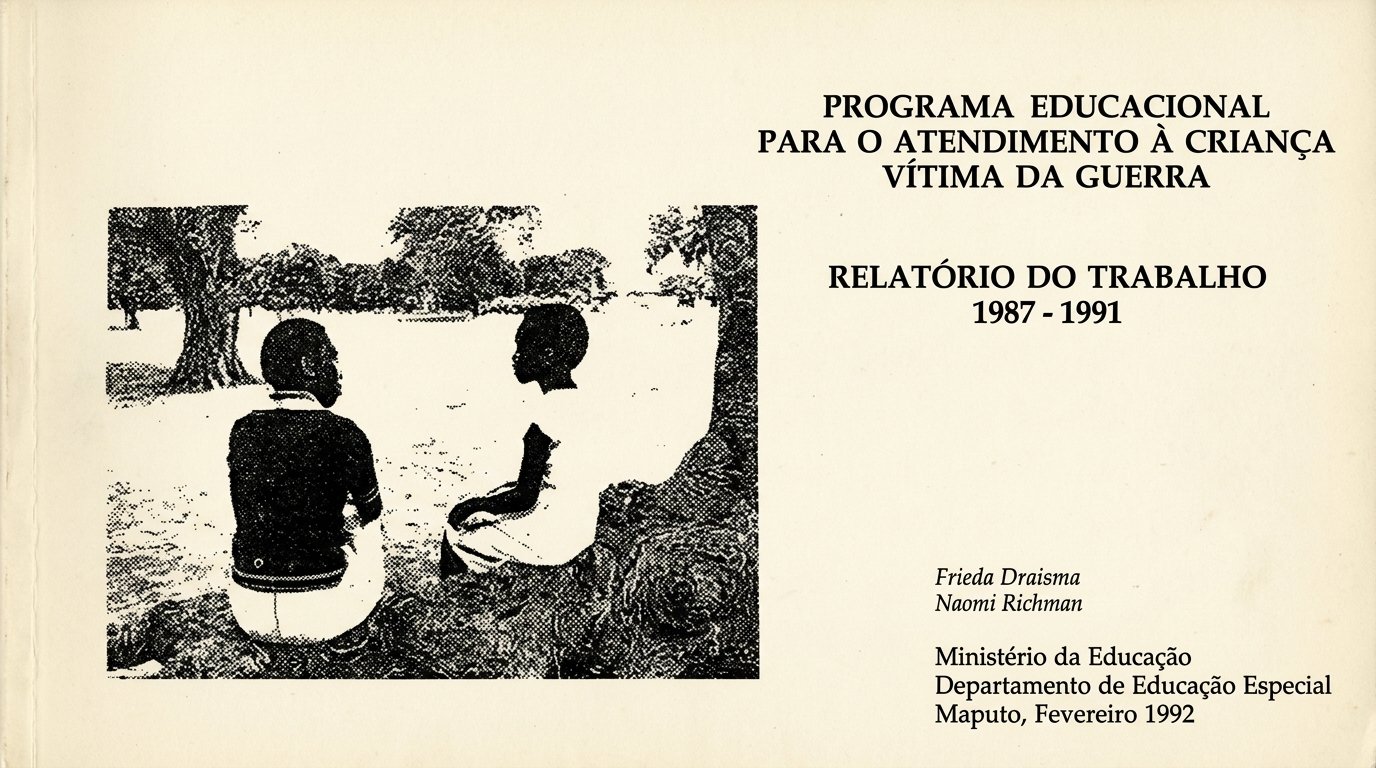
The full story of this pioneering initiative—along with research data, ethical guidelines, teacher training manuals, and real-world case studies—is documented in the official 1987–1991 report authored by Frieda Draisma and Naomi Richman.
An essential and inspiring read for educators, psychologists, social workers, and researchers in child development and emergency education.
👉 CLICK HERE TO READ THE FULL FREE E-BOOK 👈
Reference
Draisma, F., & Richman, N. (1992). Educational Programme for War-Affected Children: Work Report 1987–1991. Ministry of Education, Special Education Department, Maputo.